
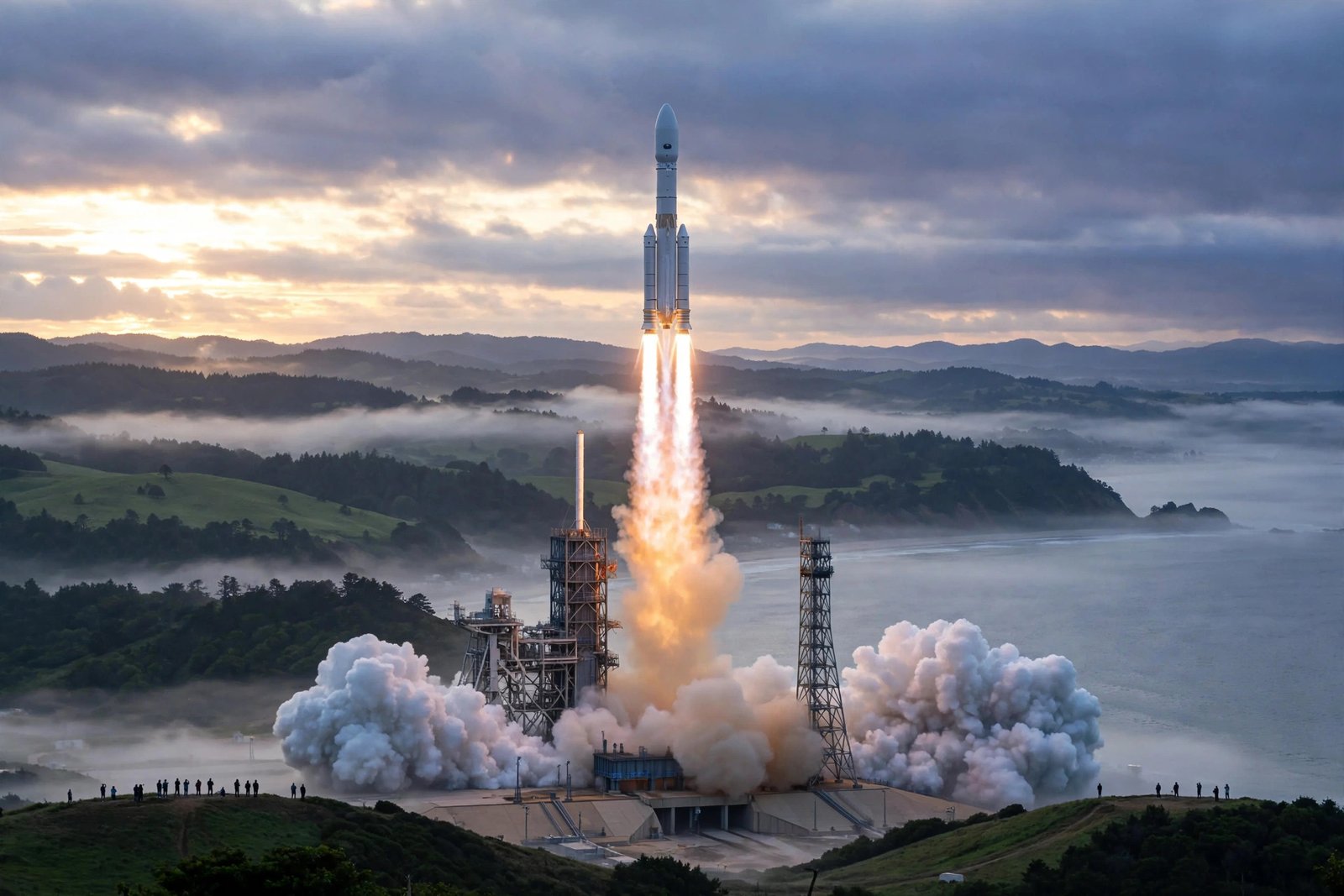
Japan has launched a spacecraft on one of the most ambitious sample missions ever attempted. The Martian Moons eXploration probe, known as MMX, lifted off aboard an H3 rocket from the Tanegashima Space Centre at 4:41 in the morning local time on Tuesday, October 20.
About 71 minutes later, the Japan Aerospace Exploration Agency, or JAXA, confirmed that the spacecraft had separated from the rocket and was safely on its planned path. The mission, reported to cost about $578 million, is the first attempt to land on a moon of Mars and bring pieces of it back to Earth.
A five-year journey
MMX will spend about a year travelling to the Martian system and is due to arrive in August 2027. It will then begin studying Phobos, the larger of the planet’s two moons, using 13 scientific instruments, including cameras, a lidar device and spectrometers.
The spacecraft will map the surface in detail, measure the moon’s gravity field and work out what its soil is made of. It will also observe Deimos, the smaller of the two moons, which scientists believe shares a similar history.
Before any landing is attempted, the team wants a clear picture of the surface. Landing on a body with such weak gravity is unlike landing on a planet, and even small mistakes could send the craft bouncing away.
A rover goes first
The main spacecraft will not be the first to touch down. In early 2029, a small rover named Idefix, built jointly by the French and German space agencies, is set to explore the surface for about 100 days. It will study the ground at close range and help controllers choose safe landing sites.
In 2030, MMX itself plans to land twice and collect at least 10 grams of soil and rock from two different locations. It gathers samples in two ways. One system uses pressurised gas to lift surface dust into a container. The other uses a coring method to take material from about 2 centimetres below the surface.
Once the sampling is done, the spacecraft will leave the Mars system, make a flyby of Deimos on the way home, and send its sample capsule back to Earth. The capsule is expected to land in Australia’s Woomera area in 2031.
The mystery of Phobos
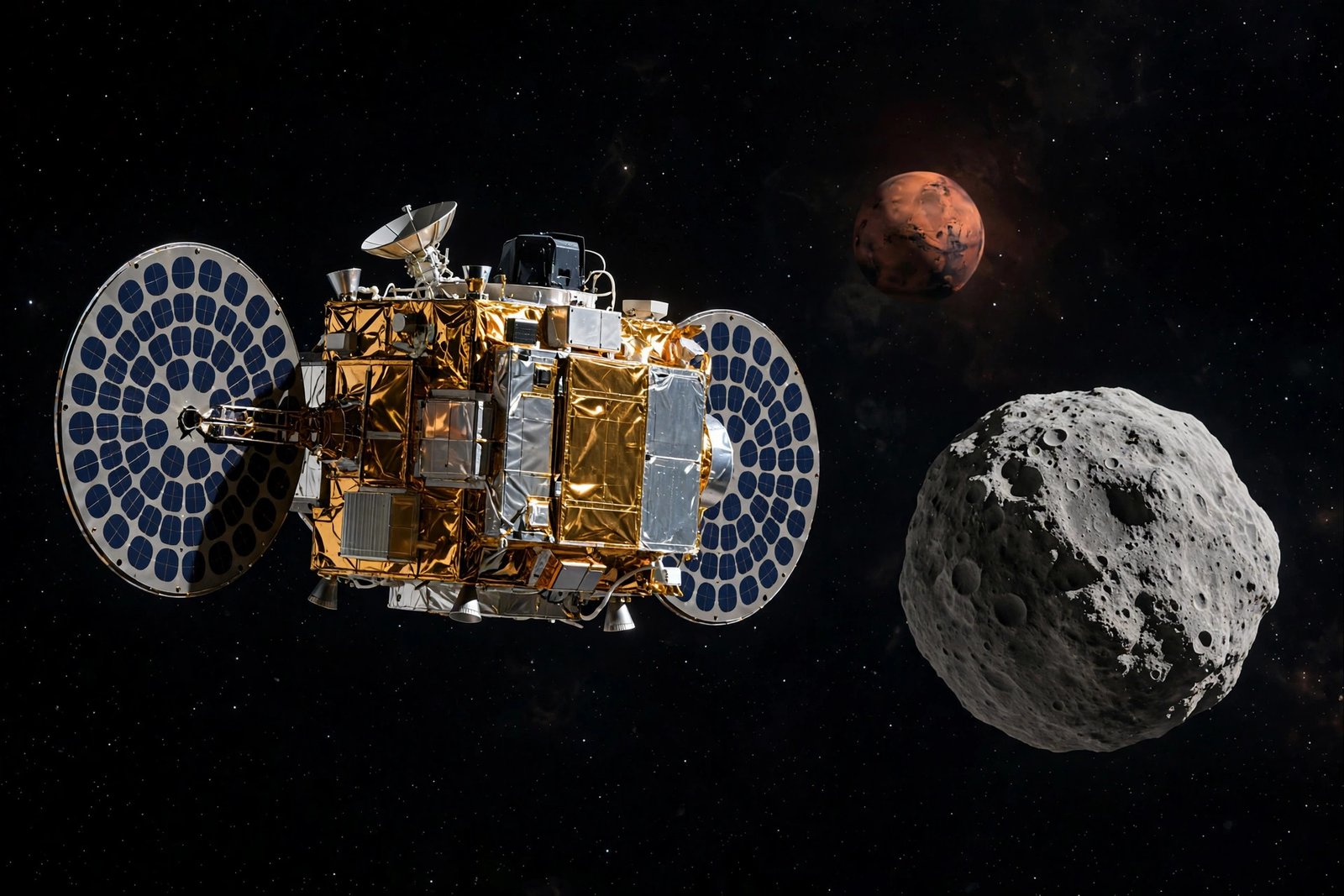
Phobos is a strange little world. It is lumpy, dark and covered in craters, measures roughly 27 kilometres at its widest, and orbits only about 6,000 kilometres above the surface of Mars, unusually close for a moon.
Scientists still argue about where it came from. Its irregular shape suggests it could be an asteroid that wandered too close and was captured by Mars long ago. Yet its orbit is nearly circular and sits almost exactly in the planet’s equatorial plane, which would be a surprising coincidence for a captured object.
The other theory is that Phobos was born from violence, formed out of debris thrown into space when a large body smashed into the young Mars. The samples should help settle the argument, because captured asteroid material and Martian debris would look very different in a laboratory.
Phobos may also hold pieces of Mars itself. Over billions of years, impacts on the planet have blasted Martian rock into space, and some of it is thought to have landed on the moon. The moon is also slowly spiralling inwards, and in roughly 39 million years it is expected to either crash into Mars or be torn apart into a ring.
Why it matters
MMX builds on Japan’s proud record in sample return missions, which includes the Hayabusa and Hayabusa2 probes that brought back material from asteroids. This time the target is far harder to reach, and the team is global. NASA, the European Space Agency, France’s CNES and Germany’s DLR are all partners in the project.
If the capsule lands safely in 2031, the samples could answer how the moons of Mars formed and how water and organic material were spread around the early solar system. Project manager Kawakatsu Yasuhiro has described the Martian moons as an unexplored frontier for humankind. Five years from now, a small capsule in the Australian desert may finally open that frontier up.