If you checked the stock market on Monday morning, you might have thought it was going to be a bad day. By the close, the story had changed. The Pakistan Stock Exchange staged a late recovery on 2 November 2026, and the benchmark KSE-100 index finished higher, even though most shares actually fell.
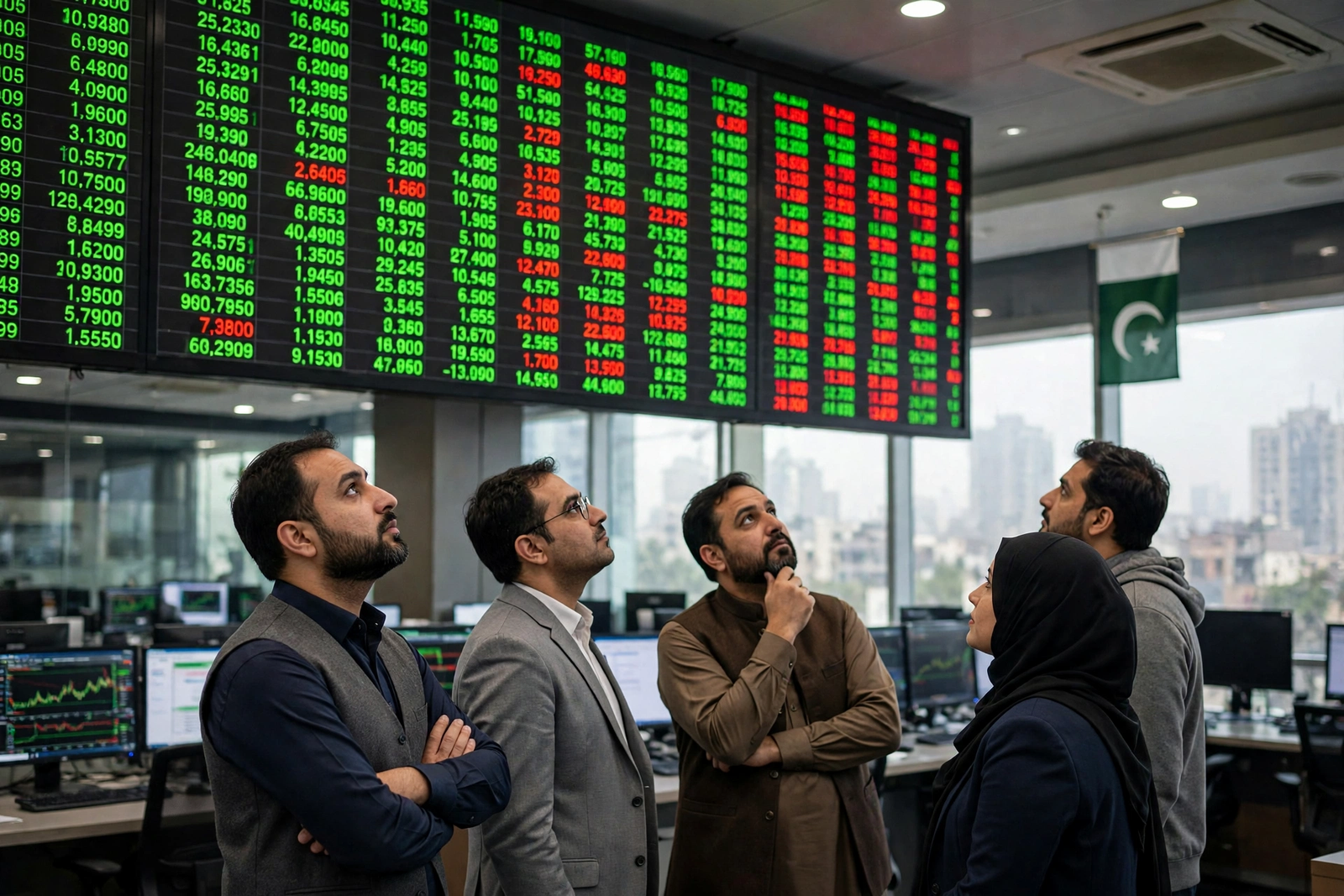
The KSE-100 climbed 154.81 points, or 0.09 percent, to settle at 166,564.07 points. That came after a shaky start. The index slipped to 166,169.41 points by 9:34 am, down 239.84 points, and later fell to 165,776.85 points by 12:29 pm, down 632.40 points from the previous close of 166,409.25 points.
The intraday range tells the story of a nervous session. The index touched a high of 166,989.76 points and a low of 165,585.42 points before settling in positive territory. In other words, traders sold in the morning, then bought back in the afternoon, and the index ended almost where it started, but just above the line.
Trading volume was much lower than Friday. The ready market saw 443.4 million shares traded, down from 825.4 million, and the value of traded shares was Rs17.7 billion, down from Rs23.1 billion. Total market capitalisation fell slightly to Rs18.293 trillion from Rs18.389 trillion, even though the index rose.
Market breadth was weak, which is an important detail for ordinary readers. Out of 496 companies that traded, 137 posted gains, 319 suffered losses, and 40 remained unchanged. That means the index rose because a few heavyweight shares carried it, not because most shares went up. Mari Energies rose 3.15 percent, Fauji Fertiliser rose 0.92 percent, and Engro Holdings rose 1.57 percent, and those gains helped the index most.
Cnergyico PK was the volume leader, with 93.2 million shares traded, closing at Rs12.28 after losing Rs1.36. Leasing companies were the strongest sector on average, while refinery shares were the weakest, which fits with the petrol pricing news that hit refineries on the same day.
One more number matters for the wider economy. October consumer price inflation rose 9.6 percent year on year, still above the State Bank of Pakistan target range of 5 to 7 percent, with energy costs elevated. Analysts at Arif Habib Limited flagged resistance at 167,500 to 168,000 as the key level to watch in the coming sessions. For now, the market survived a volatile Monday, but it did not yet show a strong new direction. This is not investment advice, just a plain reading of what happened on the day.
For a small investor, a day like Monday can be confusing. The index went up, but most shares went down. That happens when a few large companies move the index, while smaller shares fall. It does not mean the whole market is strong, and it does not mean it is weak either. It means you need to look beyond the headline number.
Volume also matters. Monday’s volume was about half of Friday’s, which suggests many traders were cautious. Low volume on a recovery day is not a strong signal on its own. It often means buyers were selective, and sellers were not in a rush. That is why analysts watch the next few sessions, and the 167,500 to 168,000 resistance level, before calling a new trend.
For households, the stock market is not the same as the price of food or petrol, but it does reflect confidence. When inflation stays above the State Bank target, and energy costs stay high, investors stay careful. Monday’s late recovery shows there is still buying interest, but it also shows that confidence is fragile, and one bad headline can change the mood quickly.
Watch the next two sessions closely. If volume returns and the index holds above 166,500, traders may read that as a firmer base. If it slips back below the morning low, Monday’s recovery will look like a brief bounce, not a turn.
Also Read: Islamabad hosts Asian Team Squash from 3 November 2026