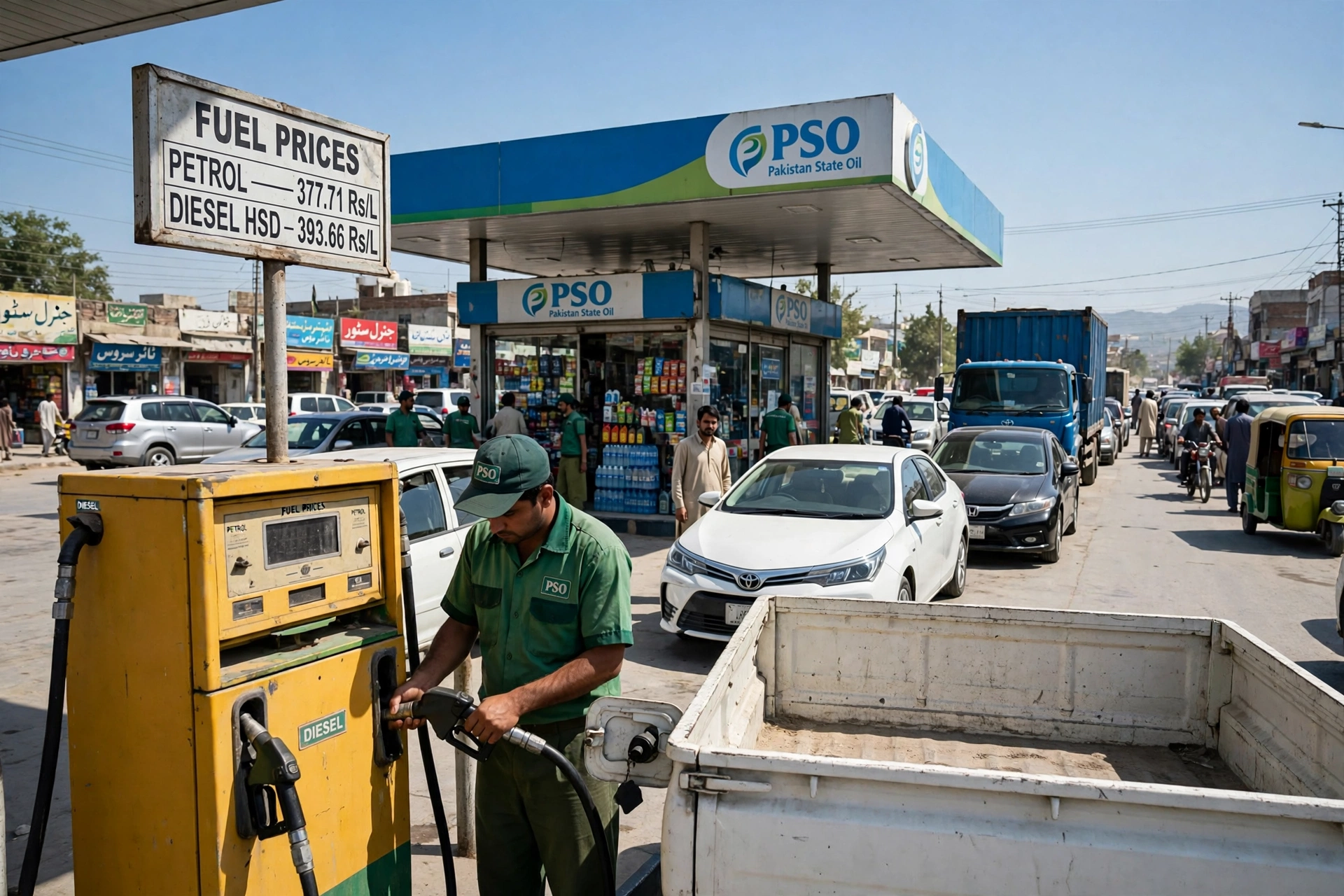
ISLAMABAD: The Pakistan diesel price has gone up again, and drivers of diesel vehicles will pay more at the pump from Saturday. High-speed diesel now costs Rs393.66 a litre, up Rs1.91 from Rs391.75, while petrol stays unchanged at Rs377.71 a litre.
The new rates apply from 24 to 26 October 2026, under a short three-day price review. The Oil and Gas Regulatory Authority, known as OGRA, revised the ex-depot prices on the advice of the Petroleum Division, under the federal government’s pricing mechanism.
OGRA said the change was needed because of global developments, including changes in Platts rates, premiums and incidentals. Platts rates are the international benchmark prices used to work out what imported fuel costs in Pakistan.
The latest move follows another change only a day earlier. On Thursday, the government had raised diesel by Rs1.64 a litre and cut petrol by Rs1.60 a litre. That means diesel has now risen twice in two days, while petrol has held steady after its small cut.
What drivers will pay
The headline numbers tell the story in simple terms. A litre of petrol still costs Rs377.71. A litre of high-speed diesel now costs Rs393.66, which is Rs15.95 more than petrol.
The gap matters because diesel powers most trucks, buses, tractors and farm machinery in Pakistan. When diesel goes up, transport costs tend to follow, and those costs often reach shops and markets in the form of higher prices for goods.
The Petroleum Division notification also set out the parts that make up the pump price. Both fuels carry a petroleum levy of Rs80 a litre and a climate support levy of Rs5 a litre. Dealers get a margin of Rs9.98 a litre, and oil marketing companies get Rs7.87 a litre.
The inland freight equalisation margin, which spreads transport costs evenly across the country, stays at Rs7.89 a litre for petrol and Rs4.71 a litre for diesel. These levies and margins remain largely steady in this round, so the change comes mainly from the import cost.
Business Recorder reported that the ex-refinery price of petrol eased slightly to Rs266.95 a litre, from Rs266.97. The import cost of diesel, by contrast, rose to Rs286.11 a litre from Rs284.19.
Average refined petrol prices eased to 117.52 US dollars a barrel, from 117.89 dollars on 23 October. Diesel moved the other way, rising slightly to 110.58 dollars a barrel from 109.47 dollars.
Global oil adds pressure
International oil prices were rising on Friday, and that added pressure to the local decision. Brent crude gained 1.40 dollars, or 1.2 percent, to 114.57 dollars a barrel by 1138 GMT, after touching 115 dollars earlier in the day.
That was its highest level since 4 May. Brent was on track for a third straight weekly gain of 4.2 percent. US West Texas Intermediate crude rose 1.48 dollars, or 1.5 percent, to 100.95 dollars a barrel, though it was poised to end the week 0.5 percent lower.
Traders linked the rise to concern about energy supplies from the Middle East, after Houthi attacks in Saudi Arabia raised fears of further disruption. Pakistan imports most of its fuel, so a jump in world prices quickly shows up in local pump prices.
The government has moved to a daily price review system in recent months, after first switching from fortnightly reviews to a weekly system. Petroleum Minister Ali Perva Malik has said daily prices are based on a seven-day average of international market prices, in line with international practice.
Under the new framework, OGRA can announce daily ex-depot prices without needing fresh approval from the prime minister or the federal government each time. Prices notified on a Friday remain unchanged on Saturday and Sunday, which is why this round covers three days.
A short cycle, not a one-off
October has brought unusually short revision cycles for fuel prices in Pakistan. The fortnightly rhythm that drivers were used to for years has given way to weekly and then daily reviews, as global prices swing with Middle East tensions.
Transport groups have not welcomed the change. The All Pakistan Dealers Association and the Transport Goods Association have both rejected the daily pricing mechanism. The transport group had earlier suspended a strike after assurances that the price fixation mechanism would be revised.
For ordinary drivers, the practical point is simple. Petrol users see no change this weekend, and their price stays at Rs377.71 a litre until at least Monday. Diesel users, including truckers and farmers, will pay Rs1.91 more per litre than they did on Friday.
There is some relief in place for small vehicles. Prime Minister Shehbaz Sharif announced a fuel subsidy on 13 September, under which motorcycles, rickshaws and other two and three-wheeled vehicles can get Rs100 a litre relief on up to 20 litres of petrol a month.
Owners of cars with engines up to 800cc can get the same Rs100 a litre relief on up to 30 litres of petrol a month. Eligible citizens can register for the subsidy by SMS.
The next review will show whether the diesel rise is the start of a longer climb or a short response to a spike in world prices. For now, the message from the latest notification is clear. Petrol is steady, diesel is dearer, and the world oil market is setting the pace.